
 Posts


Ben Bernanke's Impossible Dream | Alan Reynolds | Cato Institute: Commentary: "This whole scheme raises nagging questions. Why would domestic investors accept a lower yield on bonds if they expect higher inflation? And why would foreign investors accept a lower yield on U.S. bonds if they expect exchange rate losses on dollar-denominated securities? Why wouldn't intelligent people shift their investments toward commodities or related stocks (such as mining and related machinery) and either shun, or sell short, long-term Treasurys? And if they did that, how could it possibly help the economy?"
"There is ample evidence from commodity and foreign-exchange markets that world investors are indeed confident the Fed will raise inflation. However, the growing interest in shorting long-term Treasury bonds shows that the market does not believe higher inflation is consistent with lower long-term interest rates.
In other words, Mr. Bernanke and his FOMC allies are risking higher interest rates and inflated commodity costs in the pursuit of the contradictory objectives of higher inflation and lower bond yields, seemingly oblivious to all the evidence that they are pursuing an impossible dream."
Wednesday, December 01, 2010


Lost natural gas costs gov't $23M per year - FoxNews.com
Lost natural gas costs gov't $23M per year - FoxNews.com: "The government is losing tens of millions of dollars in potential royalties from energy companies that let immense volumes of natural gas escape into the atmosphere, congressional investigators said in a new report."
"The lost gas is equivalent to the annual greenhouse gas emissions of more than 3 million cars."
"Rusco said technology to capture the escaping gas is available and economical. He faulted the Interior Department for lax regulations on the issue and said the agency had greatly underestimated how much gas escapes from storage tanks and leaking equipment."
Tuesday, November 30, 2010
Colo. postal worker sentenced for swiping packages - FoxNews.com
Colo. postal worker sentenced for swiping packages - FoxNews.com: "A former Denver-area postal worker who pleaded guilty to stealing more than 11,000 packages and then selling their contents has been sentenced to 2.5 years in federal prison."
"The Postal Service estimates the losses at $283,913, but say there's no way to know how much was stolen."
That seems like a light sentence.
"The Postal Service estimates the losses at $283,913, but say there's no way to know how much was stolen."
That seems like a light sentence.
What Republicans Can -- And Can't -- Do about ObamaCare | Michael D. Tanner | Cato Institute: Commentary
What Republicans Can -- And Can't -- Do about ObamaCare | Michael D. Tanner | Cato Institute: Commentary: "Democratic Senator Ron Wyden of Oregon had asked for his state to be exempted from many of the law's provisions, including the individual mandate. Republicans should push to give it to him, and encourage other states to apply as well.
Republicans should also start laying out their own positive alternatives. It's not enough to simply repeal ObamaCare. Republicans will have to show that they have their own proposals for dealing with health care costs and the uninsured. They had a number of good ideas during the debate over reform, ranging from allowing the purchase of insurance across state lines to changing the tax treatment of individually owned insurance, but those ideas couldn't get much of a hearing while the president controlled the agenda. Now they can.
Finally, Republicans in the House now control the power of the purse. They should refuse to fund implementation of the bill. For example, the IRS says it will need to hire as many as 13,500 additional IRS agents to administer the law's unpopular individual mandate. Congress should refuse to appropriate the money to do so."
Monday, November 29, 2010
NJ school district: No D-grades policy a success - FoxNews.com
NJ school district: No D-grades policy a success - FoxNews.com: "Reynolds had proposed the policy last summer, saying he was tired of kids getting credit for not learning."
Tax break for employer health plans a target again - FoxNews.com
Tax break for employer health plans a target again - FoxNews.com: "The idea isn't to just raise revenue, economists say, but finally to turn Americans into frugal health care consumers by having them face the full costs of their medical decisions."
Taking the employer out of the health care picture has many benefits: More plan choices, better plan fit, cost savings.
Taking the employer out of the health care picture has many benefits: More plan choices, better plan fit, cost savings.
State workers will pay into pension fund | Hudson Star-Observer | Hudson, Wisconsin
State workers will pay into pension fund | Hudson Star-Observer | Hudson, Wisconsin: "Right now the state pays the entire employee contribution to the pensions of most state and university workers. That will change in January 2011, if only in a small way.
Most state workers will have to pay 2/10 of one percent of their retirement contributions. For an employee making about $40,000, that amounts to about $80 each year."
Did you see that? The state pays the "employee" portion!
Most state workers will have to pay 2/10 of one percent of their retirement contributions. For an employee making about $40,000, that amounts to about $80 each year."
Did you see that? The state pays the "employee" portion!
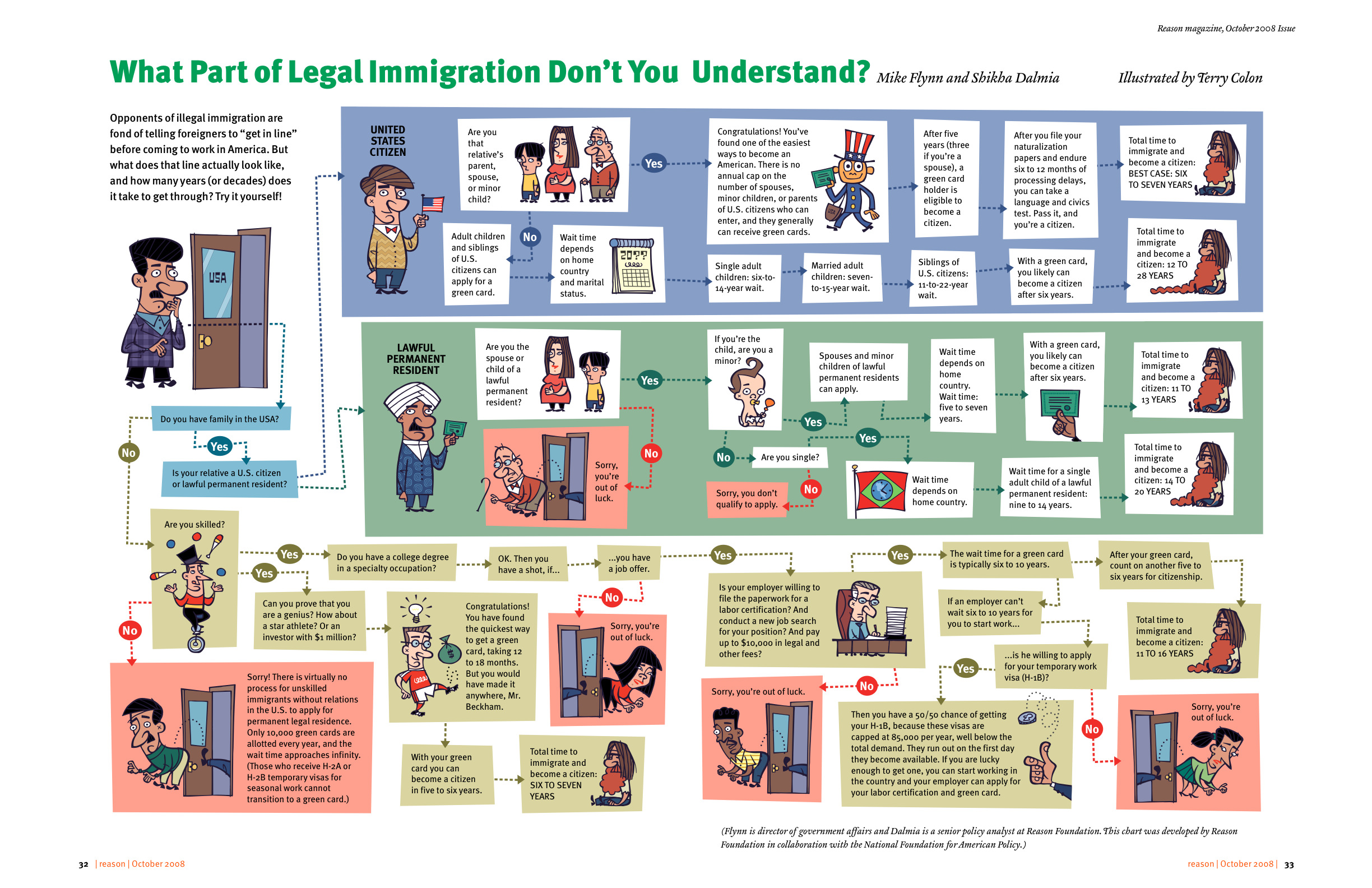
New at Reason: Mike Flynn, Shikha Dalmia, and Terry Colon on America's Absurd Immigration Waiting Line - Hit & Run : Reason Magazine
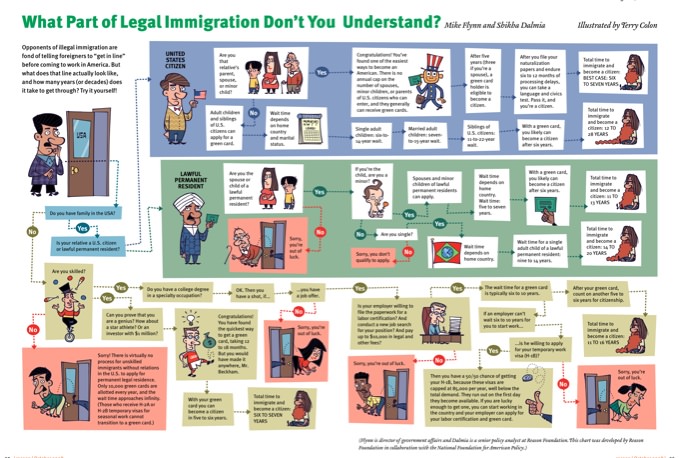
New at Reason: Mike Flynn, Shikha Dalmia, and Terry Colon on America's Absurd Immigration Waiting Line - Hit & Run : Reason Magazine: "From our October issue, Mike Flynn, Shikha Dalmia, and Terry Colon show what it takes to legally immigrate to America. Click on the image below to see a larger version. Click again to expand it.
Help Reason celebrate its next 40 years. Donate Now!"
Help Reason celebrate its next 40 years. Donate Now!"
Wednesday, November 24, 2010
Bernanke's Solutions Are the Problem - Mark Thornton - Mises Daily
Bernanke's Solutions Are the Problem - Mark Thornton - Mises Daily: "Historically, deflation was a common feature of the American economy, particularly before the establishment of the Federal Reserve. The one time that there was significant deflation and economic decline was the Great Depression.
Two economists published a study in the American Economic Review in 2004 that examined the association of deflation with depression. They looked at 17 countries and over 100 years of data and concluded that 'beyond the Great Depression, the notion that deflation and depression are linked virtually disappears."
"Possibly the worst of Bernanke's statements occurred in 2006, near the zenith of the housing bubble and at a time when all the exotic mortgage manipulations were in their 'prime.' This was the era of the subprime mortgage, the interest-only mortgage, the no-documentation loan, and the heyday of mortgage-backed securities. At the time, the new Fed chairman admitted the possibility of 'slower growth in house prices,' but confidently declared that if this did happen he would just lower interest rates.
Bernanke stated in 2006 that he believed that the mortgage market was more stable than in the past. He noted in particular that 'our examiners tell us that lending standards are generally sound and are not comparable to the standards that contributed to broad problems in the banking industry two decades ago. In particular, real-estate appraisal practices have improved.'[4] This is the equivalent of the Federal Reserve seal of approval being applied to mortgage lending at the pinnacle of the housing bubble."
"He denied there was a housing bubble in 2005, he denied that housing prices could decrease substantively in 2005 and that it would affect the real economy and employment in 2006, and he tried to calm fears about the subprime-mortgage market. He stated that he expected reasonable growth and strength in the economy in 2007, and that the problem in the subprime market (which had then become apparent) would not impact the overall mortgage market or the market in general.
In mid-2007 he declared the global economy strong and predicted a quick return to normal growth in the United States."
"Austrians were writing about the housing bubble, its cause, and the probable outcomes as early as 2003. Bernanke and others have denied that you can predict bubbles and crises"
Tuesday, November 23, 2010
Soak-the-Rich Taxes: Fail! - Robert P. Murphy - Mises Daily
Soak-the-Rich Taxes: Fail! - Robert P. Murphy - Mises Daily: "But with a progressive (or graduated) tax code, the revenues flowing into state coffers increase more than proportionally. This is because the average taxpayer is earning a higher income and is paying a higher proportion of it in taxes.
On the other hand, revenues tend to crash much harder during recessions in those states that rely on steeply graduated income taxes. Not only are taxpayers in the state earning a lower income, but many of them slip into lower brackets and hence pay a lower percentage as well.
Democratic governments are notoriously short-term in their planning. During the boom times, when state coffers are overflowing with revenues, the state legislatures ramp up spending programs. When the bottom falls out during the next slump, the legislatures are caught in a difficult position. It is no coincidence that California and New York — states with very progressive income-tax codes — also have recurring difficulties in balancing their budgets."
"Back when the federal income tax was instituted in 1913, Americans were also promised that it would forevermore remain a slight irritant to the super wealthy. Initially it imposed a mere 1 percent tax on those making under $20,000, and a top rate of 7 percent on those making more than $500,000 — a fantastic sum in those days.
Yet in 1917, a mere four years later, the bottom rate had doubled from 1 percent to 2 percent. Someone in the $500,000 bracket now faced a tax rate of 54 percent. And the highest bracket, applicable to incomes exceeding $2 million, faced a tax rate of 67 percent. (The history of federal income-tax rates is available here.) Needless to say, Americans would not have agreed to a federal income tax in 1913 had they realized what the politicians would do with it."
Subscribe to:
Posts (Atom)